Friday, April 28, 2023

Pre-Season Update

 Hey folks,

For those returning, welcome back to the golf course. For those who have just joined welcome to West Hills!! 

This post will be about the current conditions on the golf course and some the changes that have occurred on the golf course over the winter.   The 2022/2023 winter has been tough one on the golf course.  The early ice development followed by record breaking rain and low temperature periods have created situations that are problematic.  When the ice sits on the surface of the turf for prolonged periods it can cause the turf suffocate and result in poor spring conditions.  This is that type of winter.  Of our 20 greens (including the two practice greens) all but two have suffered some form of scarring from the winter. While its still early in the spring, the trees have yet to bud, we can tell that there will need to be some repairs before the greens can be opened fully.   

Number 11, 12, 13, 17,7 and 3 really took it on the chin this winter, with a loss of about 60 percent of the turf on the green surfaces.  Each of the these greens had a significant amount ice on the green when I took the snow off in the end of February.   Here's a photo of the ice. 

Roughly 2 to 3 inches of solid black ice on each green. This photo is from 16 on February 20.

A common factor with these greens is that they all have a north facing slopes. Because the sun is so low in the winter sky, and north slopes basically face away from it, the sun can't fully melt the ice or snow on the surface.  This results in re-freezing at night and thickening the of ice layers.  Add rain to the situation and ice layers continue to thicken.  To help remove the ice from the surfaces we removed the snow in late February and spread organic deicers to break up the ice.  Right afterwards, we break through the ice and pull core samples from the greens. Those are placed in water in the shop and warmed up to see what's going on. Most of the samples were weak and thin.
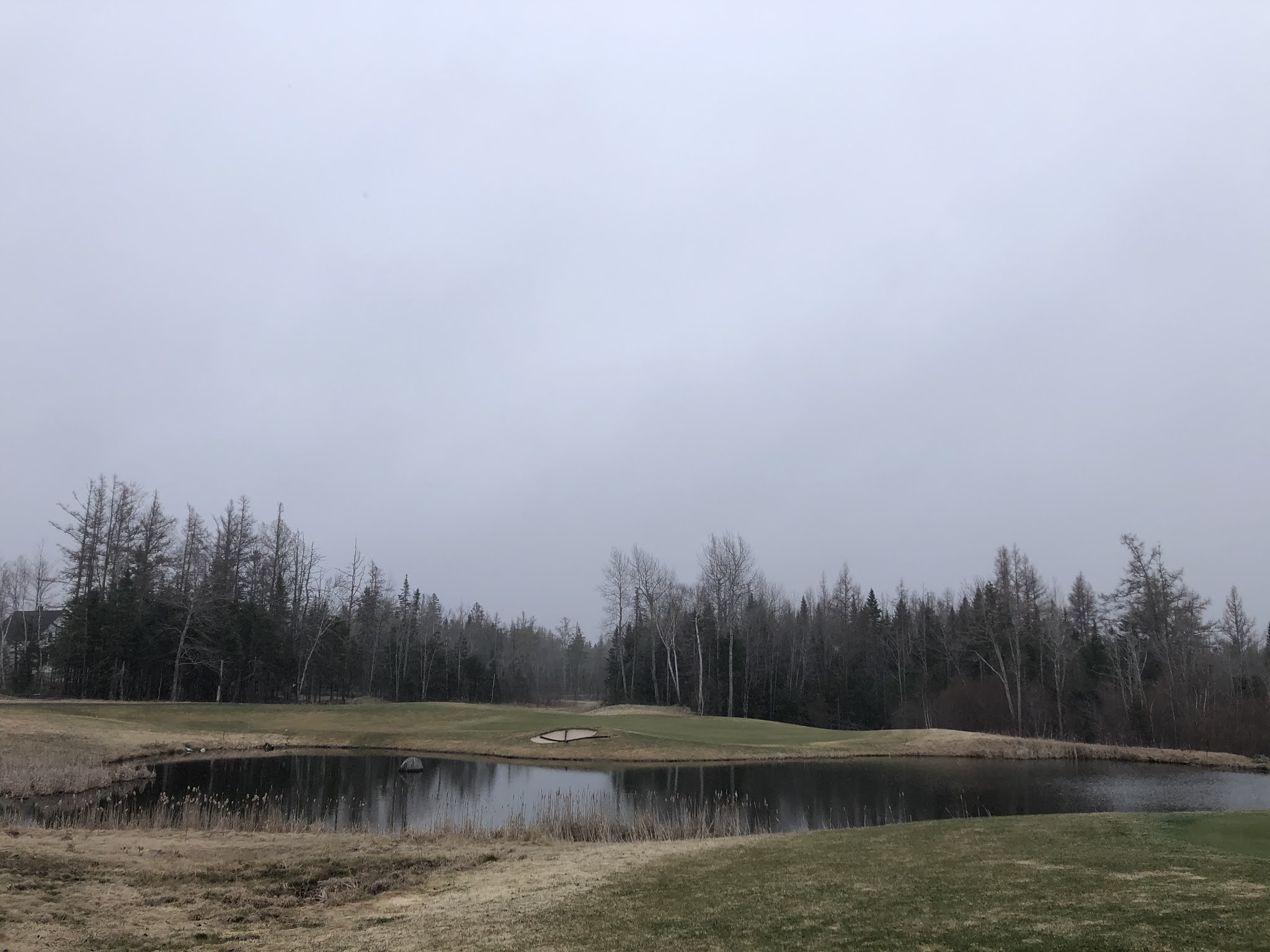
During the second week of April, right after the Masters (which by the way is awful timing) most of the two feet of snow that was on the course melted.  The unseasonably warm temps that week went a long way to waking up the turf and breaking the winter dormancy period. This really gave us an idea of what was going on and what we had to deal with.  

Number 12 April 17.  Pretty clear the low spots held water, also you can see the damage from an ATV that traveled the course late fall.

Number 13, not quite out of dormancy but the damage is evident already.

Number 7, low areas showing signs of damage.


So on these greens there is a significant amount of winter damage.  Once we are able to see the extentwe put a plan in place to begin the repair process.    The rest of the golf course faired better but was still touched by the long winter.  2, 4, 5, 6, 8, 9, 1, 15,10, and 14 greens have very small areas of damage and will recover quickly.  16 and 18 are a little more severe and as a result are we are following out recover steps to return the condition to normal. 
 The obvious question is how long will the recovery process take.  That depends on a few factors, the weather being the most important.  We have seeded, fertilized and topdressed the weak greens and have placed breathable tarps over those areas to increase temperatures.  Aside from our efforts we also need a helping hand from mother nature.  Seed begins to germinate at around ten degree, but doesn't really effectively take off until the upper teens.  The up and down temperatures we've been experiencing aren't  helpful, but doesn't cause issues with the efficacy of the seed. However it will slow its gemination rate. Warmer consistent temps are what we are after, and we haven't seen this yet. 
Once the temperatures do get to where we want, things will move quickly and in short order the course will return to normal conditions.  

Here are some photos of the slightly damaged greens:

Number 15 April 28th

Number 1, April 28th

Number 8, April 27

Number 9, April 28

Number 18, Tarped and waiting better weather.

On the subject of opening day, we haven't been able to solidify a date as of yet.  Please stay tuned to see how the course develops over the next few weeks.


Thursday, December 15, 2022

Bunker 101


 In the recent months West Hills surveyed the members about the condition of the golf course and 20% respondents replied with comments discussing the bunkers, specifically the quality.  This is a large percentage that obviously demands a response and discussion.  Its a pretty big topic that has a lot of detail to cover.  I think the best way to approach the discussion is to use some of the comments from the survey to provide backstory, clear up some miss-information and perhaps educate about what is  involved in bunker care.

Lets start with some numbers.  

There are 57 bunkers on the golf course at West Hills Golf Course and if put all together would cover 101, 838 square feet.  

That's 930 imperial tons to fill all the traps to 4 inches of sand.  This is an uncompact depth, and would require a third more after compaction. 

Each bunker on the golf course has a drainage system independent of the systems attached to the greens, tee and fairways,  with approximately 8 kms of drain tile

During normal operations it takes approximately 5 hours for 1 person to rake all the sand traps and edges, for two people its about 3 hours.  

In 2022 the traps were groomed and raked around 90 times during the time we were open, excluding any renovations from storms.

During the six month period we were open there were 28 days where rain occurred on the golf course, with a total rainfall amount of 626mm.  The average rain fall during this period is 487 mm over 28 days.

    Here are some quotes from the survey that represent the dynamic breadth of ideas regarding the bunkers.  I've omitted any names from the comments, so as to keep the opinions confidential.  I would remind everyone that the goal of this is not prove people wrong but rather provide a transparent understanding of where we are and where we are going.

"Bunkers. Do we need the tarp underneath? What would be the issue with removing it?"

    Great question.  The bunker liner is there to prevent the material from beneath contaminating the bunker sand.  The rocks, silt and clay can be pushed up by frost, washed into the sand and eventually find its way on to the green, which would be bad news for putting and for our greens mowers.  The fabric is a geotextile membrane that will allow water to pass though but not material. It comes in a 14 foot roll and is layered like roofing shingles from the low point of the bunker to the high points. These sheets are held in place with 6 inch steel staples.

The bunkers are West Hills are designed with two main things in mind.  The location/playability, and the aesthetics of the bunker as it fits into the surrounding.  The bunkers are hazards and so they are placed with the intent to penalize poor shots or create a higher degree of difficulty.  The shape of the bunkers, with  the "flashings" (the near vertical walls), are designed to increase the visibility with in the structure of the hole and present a "look".  Keeping the sand on these flashings can be difficult during large rain events, but without the liners the material beneath would erode and corrupt the sand in the bunker. So while they are a pain, they are indeed necessary.

"Some of the Bunkers could be removed since the rainfall appears to significantly impact their condition.  Often the underlay material is exposed, and the Sand ends up too thin in areas of the Bunkers.  Many players do NOT rake the Bunkers and ends up penalizing the next player."

“Another thing that I've heard others mention, but I personally never found an issue was that the Bunkers were shallow and others were hitting the black felt underneath the Sand. I understand we had heavy and frequent rain this summer which likely played a factor but maybe Bunkers need more Sand? I don't know though”

 These two statements above are somewhat accurate.  Rainfall definitely has an immense impact on the bunkers, especially with the high flashings. It is common to have the sand move from higher location to lower location. This year we had five major rain events over 40mm, each of these would have resulted in a complete rebuild of the traps.  In such cases, it takes about two days and four or five staff to push the sand back into place and then another day or so for it to dry enough to make it playable.  

The two photos below are of the fairway trap on 15 and the green side trap on number one. These photos were taken after the course had closed. You can see where the sand moves with the water, from high points to where it eventually settles.

 At one point we were debating reducing the flashing on the traps to lessen the run off. We painted a new with the red paint, lower in height and less likely to erode, but the change in shape would affect the overall aesthetics and we decided against that option.  


“I really think that the Sand Bunkers need some redesign.  The way they are designed it seems like a mtce nightmare for Adam and the staff.  There are probably 8-10 that are the worst culprits as they erode and do not drain very well.”

This statement is correct.  Bunkers in general are a pain, require constant attention and will eat a great deal of labour up very quickly. Bunkers are the largest single category of my labour budget, about 12 percent.  Compared to the greens, which are about 4 percent, it seems odd to spend so much effort on a hazard.   There have been many days this year where our goals for the day were altered due to shifting labour to the bunkers. As a long time maintainer of golf courses I see the value the aesthetics but I am critical of design features with form over function.  Given my druthers, I would do away with the lot and spend the effort and money on repairing divots, but that's subject for another post. 

Lets talk about some drainage.

Here's and example of the drainage plans for each of the bunker complexes. This is number one green side bunker.  The smaller broken line is the four inch big "O" that runs from the trap and ties into the larger fairway drain exit.

    Much like any construct, bunkers are not static creatures and will require repairs to the infrastructure.  Each year there are bunkers that will have the drainage corrupted and need to be cleaned up.   My expectation is that after a 20 mm rain the bunkers should drain in a 24 hour period, longer than that it goes on the list of slow drainers.    Below are photos of the work we did on 15 green side.  The 3 bunkers in front of the green and one of the two to the right were corrupted.  The sand is pulled back, the liner is pulled up and the drain line is located.  We then use the high pressure irrigation hose to flush the drain line and ascertain what the problem is.  Usually it's a case of silt blocking the liner from draining, but it could be any number of things.  Broken pipes, frost heaved rocks, and even critters moving in and blocking the lines.  Once the flow is good, the liner is replace and any contaminated sand is removed. Then a new load of sand is added. Most of this work is done by hand and the guys have been doing a great job.  Our list for the spring includes the following bunkers, #1 greenside, #9 first fairway, # 12 greenside, # 15 back right greenside, 18 fairway left, 18 back right greenside and the practice bunker.


“- it's no secret that the Bunkers need re-work.  They consistently have little to no Sand, and are depleted by rain, etc as soon as they are filled... "

The vehicle below is one our Toro HDX Workmans, and its payload capacity is roughly a ton of sand.  That means when we have a highway trailer of sand delivered to the golf course from Nova Scotia, we will have about 37 of these to distribute across the golf course. This is a yearly process, and since opening in 2018 we have added two or three loads per year (with the exception of 2020, due to the pandemic). In 2022 we had two trailers delivered in addition to the load we had in stock (we stock one over winter so its available in the spring). So that makes about 100 loads with our Workman's that we can add to the traps. The sand is quite expensive and we are careful about where it goes, picking the areas that require it the most.

 Rain will wash the sand to the base of the trap but will not deplete the volume in the bunker.  Depletion is mostly caused by play.  That can be hard to believe but take 17 greenside bunkers as an example.  On a busy day we have 250 to 300 players use that hole, if just 3 players out of 20 land in the trap that's 45 players. My sand wedge face is about 3 by 3 inches, and being the garbage sand player that I am, I'll probably blast all of that out of the trap. That's 2.8 square feet of sand being blasted out of the trap on a daily basis. 

Regardless of the math its clear we need to increase the amount of sand added and will do so in 2023.


“Despite the addition of Sand in some Bunkers throughout the season, there's still a very dense layer of packed Sand underneath the thin layer of "nice" sand on top. A phenomenon I've never regularly experienced at any other golf course. The inconsistency from bunker to bunker can be frustrating.”

  The lower portion of the traps can become compacted from moisture (irrigation runs on a regular basis) and the process of raking.  In 2019 we observed that the metal rake, which has 2 inch teeth, would catch the liners and pull or tear them.  As a solution we switched the rake on out bunker bike to hard foam rake. The foam rake has a nicer finish but it fails to cultivate the sand as the metal rake would, hence the thin layer of "nicer" sand on the top and compaction in the bottom.

The metal rake attachment for the sand pro.  


The foam rake attachment for the sand pro.

Our solution for this is an attachment for the Bunker Bike that hooks to the belly of the machine before the foam rake that "scarifies"  the sand prior to the rake passing over it. Typically we shoot for about three inches of sand on the flashings and and about four to five in the base areas. Our intention is to only use this attachment in the lower portions of the bunkers, where the sand is deeper. Loosening the sand should better the consistency, lessen the compaction and improve drainage.  There will be some trial and error but we will figure it out.  

This is the belly mounted attachment for the Sand Pro


So to sum up the changes we intend to do the following.  

Increase the amount of sand we put in the traps through out the season.  We have budgeted for  an additional three loads, which will be distributed based on sand levels.

Continue to repair any corrupted drainage.

Alter the structure of low points in the bunkers by way of a scarifier attachment on our bunker bike, which will reduce compaction, increase consistency and increase drainage.

We have added funds to the budget to allow for more staff/training to tend the bunkers, and will concentrate on weeds, liners repairs, edging, and managing sand depths.

If you have any questions free to reply to this blog, email me at adamfletcher@westhillsgolf.com or drop by the shop and have a chat!  Have a great winter in see you folks in a few months!! 


Friday, April 16, 2021

April 15, 2021 Course and Club House Update

 Hi Folks,

I hope this update finds all well and still excited for the upcoming year.  The snow has finally melted, even in the dark corners of the golf course and the frost is coming out of the ground.  Work continues on the club house, both exterior and interior, and we are working on the course to recover from the winter.

Like the March Update I'll lead with some photos of the Club house so you can see the progress.  


The Multi Purpose room on the second floor is really taking shape now that the drywall has been installed.

Multi Purpose room from another angle.

Although hard to see (no lights installed yet) this will be the simulator room and the members lounge.  The open space in the wall will house a window to spectate and or heckle.

The stone patio out side the restaurant is almost finished and the siding is being installed

Same patio from the south side

Here's the club house from the one tee side. The stone work on the wall facing the parking lot is making great progress and looking great! 
The interior of the existing clubhouse is also getting a facelift.  We are adding an office for Brett and reconfiguring the hall to create an entrance to the new facility.

Another view of the clubhouse from 9 approach.

The slightly warmer weather we've been experiencing is beginning to show us where the golf course has suffered from the winter.  As predicted from the samples we had pulled early March, there are pockets of ice injury around the golf course. 18, 10 13, 7 have taken the worst of the damage, suffering roughly a 60 percent loss sporadically around the greens and predominantly in the low areas. 

18 green Ice damage


Number 7, back of the green

Number 10 green freshly tarped. Our tarping team today from the left are Mack, Lincoln and AJ.

Number 7 in the front.


 The current temperatures (with the exception of a few out lying days) have been below the level where the turf will really take off.  I am encouraged by the growth that we’ve had already, during the small amount of warmth we experienced.   The healthy plants will take advantage of the warmth and grow more quickly while the damage plants will be slow to show any movement.  As things get warmer and the plants find themselves in better growing conditions the less healthy will show improvement.   

Our process to correct the damage includes a hard brushing in both directions, fertilize with plant available liquid fertilizer, over seeding with our bent grass seeder, roll and then covering the green with a tarp to elevate the temperatures.  We would normally include watering the seed, but I am concerned about any lingering frost in the ground that might damage the irrigation system.   This weekend is supposed to be wet, and we will most likely charge the system next week to continue keeping the seed moist. As a side note, this is the earliest I have ever seeded in New Brunswick, typically the first week of May is our target.


Here's the tarp installed on 18. The tarp elevates the soil temperature and helps to reduce loss over night.
It’s unlikely to see much germination while the temperatures are this sporadically low but in the event we see some growth, we will be that much further ahead.  There is no magic pill for recovery from these situations, it's more of war of attrition.  We seed, tarp, hope for growth, seed, tarp, hope for growth.  As the weather improves each seeding layer will see better results, until the damage is fully recovered. 

 2, 3, 8, 11, 16, 9 also suffered some injury but at a much lesser degree.  These areas are of lesser concern, main due to their smaller size and reduced but not decimated population.  I expect as the conditions improve these will areas will get smaller.  Treatment remains the same, brush, fertilize, seed and tarp. 

Number nine green from the club house, the whitish areas are the damaged sections.


This is the "reduced but not decimated population" area on 13 green at the back left. This will improve much faster as there are already mature plants in place.  


Here's the same spot on 13 but from viewed from 18tee. The guys are tarping just the weak sections.


That leaves 1, 4, 5, 6, 12, 14, 15, 17 in great shape. 

Number 2 from the back, looking great!

Number 4 from the back, also looking great!

Number five from four green, you guessed it, also looking great!

On the whole not a terrible winter result but we definitely have some work to do.  At this point we are still looking at our traditional opening date of Mid may,  but are optimistic with good weather and some luck we might be earlier.  Please stay tuned for further updates and a discussion about moving the putting green!

Thursday, April 1, 2021

March Update 2021

Hey Folks,

Happy New Year and welcome!  Thanks to the those who have decided to return and to those who have chosen to join us for the first time.  When I started here in 2016 the golf course had nine holes with about 90 members and since then we have grown in so many ways.  Our community has expanded to include more streets and homes, the golf course has increased to 18 holes with attention to detail and playing conditions, and our membership has increased to over 400 great people that are awesome to work with.

In keeping with our efforts to continue the offerings at West Hills, the 2021 season will bring with it a state of the art club house featuring Saint James Gate restaurant, a second floor with golf simulator and multi purpose great room, and many more amenities for your use. 

While all of this has little to do with the actual cultivation and maintenance of the turf I'm pretty excited to be part of this project and wanted to share a portion of that with you! Here are some photos of the clubhouse and the interior during the construction.

The view of the club house from 15 tee.

From between 18 and 9 greens.

From 9 green.

This will be the view of nine green from the second floor deck in the previous picture.

18 Green from the same deck as the previous picture.


From inside the second floor, this is a common room overlooking 18 green, with doors opening to the deck in the previous two pictures.

The ground floor where the restaurant will be situated, with 18 foot windows overlooking 9 and 18 green.

The view from the common room on the second floor over looking the 18 green.

Obviously there is still quite a bit of work to be done but the crew are here everyday making progress with the construction.  

Now on to the turf.

As far as winters go, the 2020/2021 season was pretty tame.  Not really a whole lot of snow, but cold by average standards.  We didn't really have any significant snow fall accumulation until at least the 16th of January, and there fore, a reduced amount of ice build up on the playing surfaces.  The average temperature in March this year was about 6 degrees colder than the historical average, and the heating degree days were more than the average by about 40 degree days (basically means we needed to run the heat more often when below 18 degrees C) . Not a terrible winter by any means. 

By the second week of March I had begun the process of removing the snow from the greens. For the most part things looked pretty good. Most of the greens had some form of ice on them, and definitely sections where it could be problematic but not a global issue.  I took some samples of the those areas and put them in the shop to warm up. 

The path to 16 green


Three green.

This is a cross section of the snow on 15 green.  The layers exposed here represent the thawing events through out the winter where the snow melted and created an ice layer on the surface.  Then subsequent snows build up until the next thaw. I always hope for this kind of pattern as it acts a natural barrier to keep ice from the green.  


The term "winterkill" is often used to describe the death of turf from various causes during the winter months. It's a layman's term that covers any reason for turf loss but usually the culprit is either one of the following or a combination of each. Here are some excerpts from earlier blogs where this is explained.

During the winter the environmental conditions at ground level are conducive to fungal growth that thrives in the wet and cold.  Pink snow mould will form within 2 months of snow coverage and Grey Snow mould within three months coverage.  If left untreated these two fungi can devastate a golf course.  As part of the prevention program a fungicide is applied late in the fall to protect the turf beneath the snow.
 
The disease pressure this year was extremely strong, most likely because the turf was very wet and still not completely dormant prior to the first snows in January. Any areas not treated (mainly the rough) are showing signs of damage.  Fortunately, due to the length of the turf in these areas they should recover quickly.

This is from the walk up to 13 green, Being in the rough its not an area we would normally treat and is quite thick with mould this year.

Number 17 tee.  The left side of the photo (the tee surface) was treated, and the right (the rough between the cart path and the tee) deck was not.

Another form of injury to the turf from the winter is prolonged ice coverage.  The injury varies in severity based on the species of turf and the duration of the ice coverage.  Poa Annua, an invasive native turfgrass, can only survive ice coverage for about 45 days.   Bent Grass, the turf species used in most northern green’s construction, can survive longer stretches of ice coverage, almost twice that of the Poa.  In very general terms, the ice encases the plant and suffocates it.  So far I have seen little evidence that the ice that had developed on the course has caused extensive damage.  There are definitely pockets of trouble, much like last year, but it remains to be seen how extensive that damage is.

Number 10 Green right after I had cleared it.  This green had a considerable amount of ice on it.

Ten green with about three inches of ice.

A great example of what walking or driving on snow on the green can do. These are snow shoe tracks on ten green.  The snow gets packed down and eventually forms ice on the surface.  If you chose to walk on the course be mindful of where the greens are.


The putting green.


"Winterkill" also comes in the form of Crown Hydration Injury.  This typically occurs during the late winter and early spring portions of the year.  Plants generally slow to a form of dormancy that aids in winter protection, remaining until temperatures are once again high enough to begin the spring growth period.  Similar situations are evident with trees and shrubs, buds start to form, and the plant wakes up.  Occasionally we have a few warm days in March or April that fool the turf into believing the its time to get started.  The crown of the plant (where the leaves grow from) flood with cellular activity and the plant begins growing. 

Unfortunately, these warm days are usually followed by a very cold night or two and the plant basically freezes, the cells break, and the plant desiccates.  As with ice damage, the severity of crown hydration injury varies with the species, mainly based on what temperature that species emerges from dormancy at. Poa Annua will begin cellular function at 8 degrees Celsius, making it much more susceptible to injury from an early spring warming period.  Bent Grass will hold out until 14 degrees Celsius before cellular active begins, making a more resistant to this type of injury.

This has to be considered when taking the snow off the green. After removing the snow this year we had a cold snap follow the the exposure of the greens. I was concerned about the bent grass suffering from crown hydration injury.  The samples I had pulled on the 15 of March were showing growth the end of the week and I was pleased to see that the Poa had actually suffered much more than the bent grass.  


The sample from 9 on the 16th of March


Number 9, 4 days after sampling at 20 degrees Celsius.  Note that some of the tips are burnt, but he crowns, where the plant grows from, are greening up.


This is the same green 14 days later at 20 degrees Celsius.  The dark green leaves with pointed tips are the bent grass and the rounded tip leaves that look unhealthy are the Poa Annua plants. Clearly, there is a difference in the growth pattern.

While the samples look good, we have to remember that I am sampling a very small portion of a very large area.  In the series of photos above the time span is about 14 days in  a controlled environment at a set temperature. As the soil temperature warm up we will have a better idea of the conditions.  Please stay tuned and if you have any questions feel free to ask away! I enjoy the feed back and look forward to hearing from you!